Targeted, playful programs that build clear speech, richer vocabulary, and confident everyday communication.
Communication is more than words — it's gestures, eye contact, listening, and connection. Our speech-language pathologists meet each child exactly where they are.
Sessions are playful and structured around your child's interests, so new sounds, words, and sentence patterns feel like a game rather than a drill.

Evaluation of articulation, language, and comprehension levels.
Clear communication milestones tailored to your child's age & needs.
Interactive exercises using stories, games, and daily routines.
Simple take-home activities to reinforce progress between sessions.
Focused sound-by-sound work to build clearer, more confident speech.
Interactive, story-led sessions to expand expressive & receptive language.
Turn-taking, conversation, and peer-interaction practice.
Gentle, structured techniques to build smoother, steadier speech.
Alternative communication tools for minimally verbal children.
Practical home strategies to reinforce every session's progress.
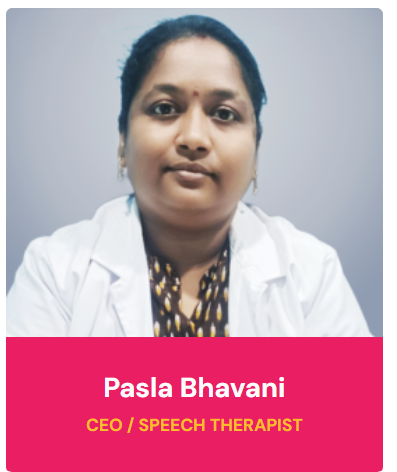
With over 8 years of specialized pediatric speech therapy experience, Pasla Bhavani combines phonological training with play-based oral motor exercises to help non-verbal and speech-delayed children express themselves naturally and confidently.
While an isolated speech delay affects spoken words, autism spectrum disorder usually involves differences in social communication (eye contact, joint attention, pointing) and repetitive behaviors. Our comprehensive diagnostic intake precisely differentiates between them.
We introduce Augmentative and Alternative Communication (AAC), visual picture schedules (PECS), and gestural cueing to reduce frustration immediately. Non-verbal therapy builds intentional communication before verbal sounds emerge.
Yes. Our speech pathologists use fluency shaping techniques, breath control protocols, and oral-motor placement games to correct phonetic distortions and ease dysfluency.
Speaking multiple languages does NOT cause speech delay. We guide parents on how to provide rich, consistent linguistic input across home languages (Telugu, Hindi, English) without confusing the child.
Initial shifts in intent, eye contact, and imitation typically emerge within 4 to 8 weeks of consistent weekly sessions, followed by steady expansion in vocabulary and phrase lengths.
Consult with our lead speech-language pathologist in a relaxed, child-friendly environment.